Does Toyota Make a Camper Van? What to Know
If you’ve been asking yourself "does toyota make a camper van," you’re not the only one. The direct answer is no, Toyota doesn’t sell a factory‑built camper van in the United States as of 2026. But that short answer hides a much more interesting reality.
The closest Toyota vehicle to a camper van is the Sienna minivan. With standard all‑wheel drive and a combined 36 mpg from its hybrid powertrain, it’s a surprisingly capable platform for a conversion. Aggregate owner reports show thousands of DIY and professional Sienna builds on the road today.
So while Toyota doesn’t make a camper van, the options to get one are very real.

Image source: YouTube / Jodi’s Gemboree (YouTube thumbnail (fair‑use with source credit))
Does Toyota Make a Camper Van? The Short Answer First
No, Toyota does not manufacture a factory camper van for the US market. But that’s not the end of the decision. You have three genuine paths to a Toyota camper: convert a Sienna minivan, pair a Tacoma or Tundra with a slide‑in camper, or buy a vintage Toyota‑based motorhome from the 80s or 90s.
Each route has its own trade‑offs.
Why This Question Is Trickier Than It Sounds
Part of the confusion comes from how other brands handle the camper van market. Ford offers the Transit with a factory‑approved camper package. Ram has the ProMaster, Mercedes the Sprinter.
Toyota has no equivalent in North America. But that doesn’t mean the brand is absent from the camper world.
In Japan, Toyota sells the HiAce, a popular platform for camper conversions, and the European market gets the Toyota Proace. Those never made it stateside. So American Toyota fans are left to improvise.
That’s why a straightforward “no” doesn’t capture the full picture.
The three options available here, minivan conversion, truck camper, vintage motorhome, each represent a different use case and budget. Understanding which fits your life is the key. If you’re open to other styles of camping, a high‑quality tent might be a simpler starting point, but these Toyota‑based builds offer mobility and protection that a tent can’t match, even when you compare them to choosing the right shelter for a weekend trip.
Option A: The Toyota Sienna Minivan Conversion
The Sienna is the most practical modern option for a Toyota camper van build. It’s a common choice for stealth camping, weekend trips, and even full‑time van life on a budget.
Why the Sienna Works for Camping
The Sienna comes with several advantages that make it an attractive conversion platform.
- All‑wheel drive is standard. Every new Sienna since 2021 comes with AWD as standard. That’s rare in the minivan world and gives you confidence on dirt roads or in snow.
- Excellent fuel economy. The hybrid powertrain gets a combined 36 mpg per EPA estimates. That’s nearly double what a typical Sprinter or Transit gets. Your wallet will thank you at the pump.
- Versatile seating. Stow ’n Go seats fold flat into the floor, giving you a clear cargo area. The third row disappears completely. You can sleep on a platform or install a modular build.
- Stealth factor. The Sienna looks like a family minivan. You can camp overnight in parking lots or on city streets without drawing attention.
- Reliability. Toyota’s reputation for reliability carries over fully. Sienna owners routinely report 200,000 miles with basic maintenance. That matters when your home is on wheels.
- Lower entry cost. A used Sienna (2021 or newer) runs $30,000 to $45,000. A professional conversion adds $10,000 to $30,000. The total is still well below a new camper van from Ford or Mercedes.
But if a minivan feels too cramped, a spacious tent with room to stand might suit your style better. That’s fine, a well‑chosen pop‑up can give you that standing space without a permanent vehicle build.
Where the Sienna Falls Short
It’s not all roses. The Sienna has some real limitations for camper duty.
- Headroom is minimal. The interior height is about 48 inches. You cannot stand up inside. That means cooking, dressing, and changing happen hunched over or outside. For camping where you need to stand and move freely, a good wall tent provides more comfort.
- No high roof option. Unlike the Transit or ProMaster, there is no factory tall‑roof Sienna. You cannot install a pop‑top without serious engineering and potential roof damage.
- Payload constraints. The Sienna’s payload capacity is roughly 1,200 to 1,500 pounds depending on the trim. Once you add passengers, gear, water, batteries, and a build‑out, you can hit the limit quickly.
- Hybrid battery placement. The hybrid battery sits under the floor between the front seats. This eliminates the most natural spot for a water tank or large storage. Many builders relocate the battery or work around it, which adds complexity.
- Roof load limits. Toyota specifies a low static roof load. Installing a roof fan, solar panels, or a cargo box requires careful weight management.
What a Typical Sienna Build Looks Like
Most Sienna camper conversions follow a simple formula. Owners remove the middle and rear seats. They build a platform bed in the back often with storage drawers underneath.
A portable stove and a cooler serve as the kitchen. A secondary battery like a Jackery or a DIY lithium system powers lights and electronics. Many keep it minimal: a mattress, blackout curtains, and storage bins.
If you want a more permanent setup, professional builders like Peace Vans or Adventure Wagon offer complete Sienna conversions. They install cabinetry, a sink, a propane stove, and an electrical system. But the cost rises fast.
Option B: Toyota Truck + Slide‑In Camper
If you want off‑road capability and don’t need to stand up inside, a Toyota pickup with a slide‑in camper is a strong alternative.
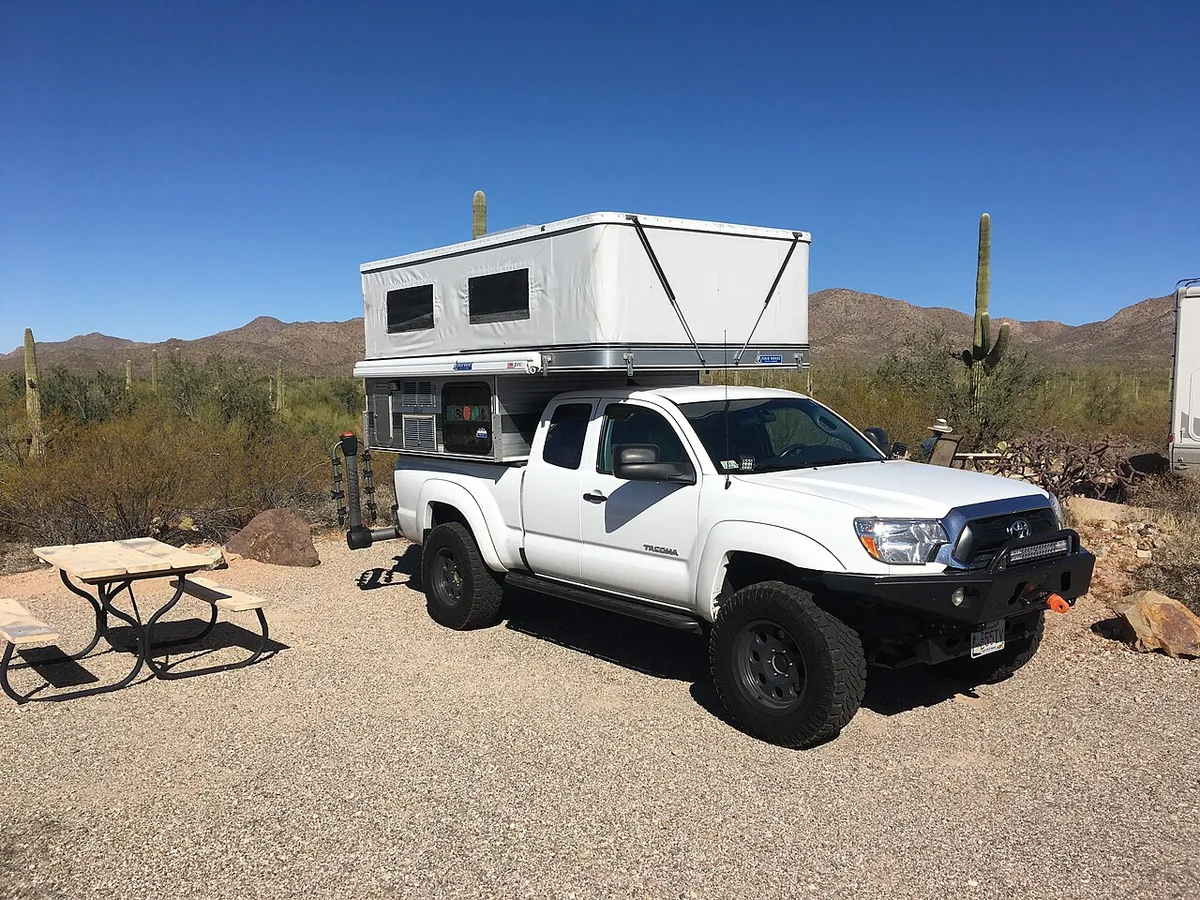
Image source: Wikimedia Commons / Gillfoto (CC BY‑SA)
Tacoma vs. Tundra for Camper Duty
The truck you choose determines what camper you can carry.
- Tacoma, The mid‑size Tacoma has a payload rating between 1,100 and 1,600 pounds depending on configuration. That limits you to lightweight pop‑up campers like the Four Wheel Camper Hawk or a Go Fast Camper. You can’t fit a full‑size hard‑side camper without exceeding GVWR. The Tacoma is nimble off‑road and easy to park.
- Tundra, The full‑size Tundra offers 1,700 to 2,300 pounds of payload. It can carry a heavier, hard‑sided camper with a bathroom and kitchen. The fuel economy suffers (15‑18 mpg), but you get more living space.
Pros and Cons of a Truck Camper Setup
Pros:
- The camper and truck are separate. You can remove the camper and use the truck for daily driving.
- No permanent build‑out required. Campers come pre‑wired, insulated, and ready to use.
- Better off‑road capability than a minivan or cargo van, especially with 4×4.
- Standing room is often possible in slide‑in campers.
Cons:
- High center of gravity affects handling.
- Reduced visibility with a camper in the bed.
- Truck campers are expensive. A new pop‑up can cost $10,000 to $20,000; a hard‑side can exceed $30,000.
- Fuel economy drops significantly with a camper loaded.
- Less stealthy than a Sienna.
The separate camper design lets you drop the camper and set up a base camp, similar to using a large tent. If you enjoy that kind of flexibility, learning the basics of a good tent setup can be just as rewarding.
Option C: The Vintage Toyota Motorhome Route
For some, the only “real” Toyota camper van is the motorhome built on a Toyota chassis in the 1980s and early 1990s. These are not factory Toyota RVs, they were built by independent RV manufacturers using Toyota truck platforms. But they carry Toyota drivetrains and badges, so they count.
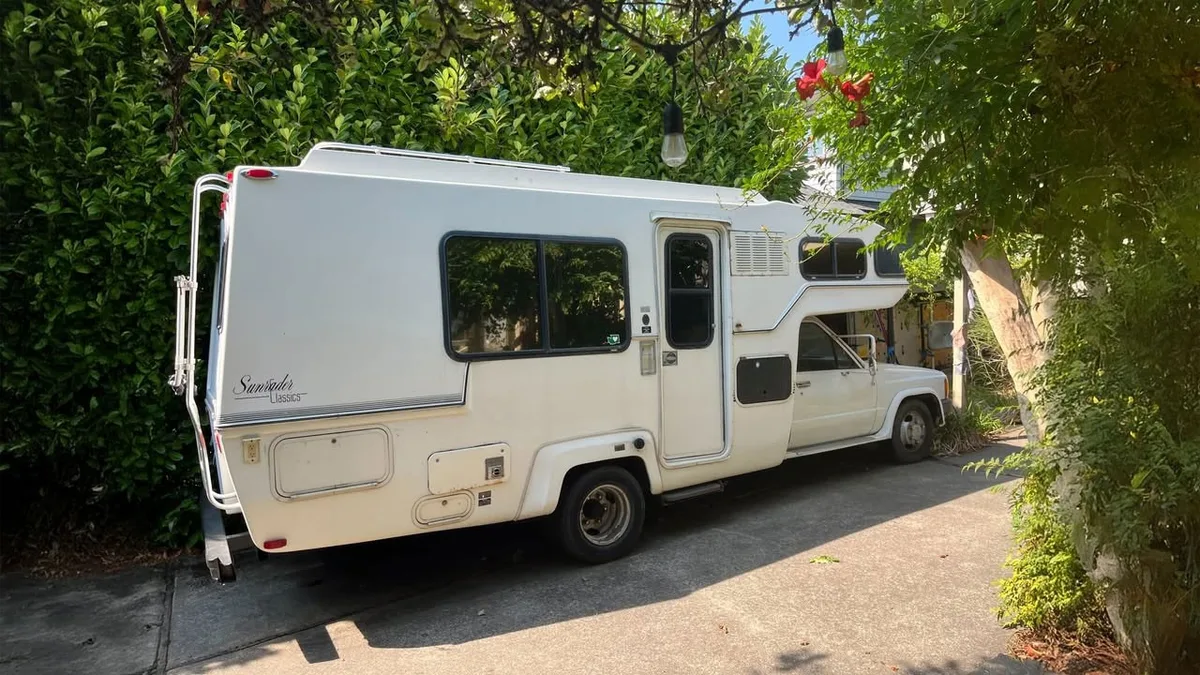
Image source: YouTube / Toyota RV For Sale (YouTube thumbnail (fair‑use with source credit))
What You’re Actually Buying (Sunrader, Dolphin, Warrior)
Three brands make up most of the vintage Toyota motorhome world:
- Sunrader, Built by Gardner Pacific. The Sunrader has a one‑piece fiberglass body. It’s lighter and less prone to roof leaks than its boxier competitors. It’s also rare and commands higher prices.
- Dolphin, Made by National RV. A box‑style motorhome, more common and generally cheaper. Available in 18‑ to 21‑foot lengths.
- Warrior, Also by National RV, similar to the Dolphin but with a different floor plan.
All are built on the Toyota pickup chassis with the 22RE 4‑cylinder engine. They are slow but reliable and surprisingly capable off‑road due to their light weight.
The Reality of Owning a 30‑Year‑Old RV
Age brings problems. Rot in walls and floors is almost guaranteed. Plumbing and propane systems need inspection or replacement.
The 22RE engine is bulletproof but parts are becoming harder to find. Body panels, windows, and interior fittings are specific to each model and often unavailable.
Buying one is a gamble. Prices range from $3,000 for a project that needs everything to $25,000 for a fully restored example. The right buyer is someone handy with tools and patient with old systems.
For those not ready for that kind of commitment, a modern air tent offers quick setup and reliable shelter without the maintenance headaches.
The Comparison Table: Sienna Conversion vs. Truck Camper vs. Classic Toyota RV
Let's put the three options side by side. This table covers the factors that matter most for a buying decision.
| Factor | Sienna Conversion | Tacoma + Slide-In Camper | Vintage Toyota Motorhome |
|---|---|---|---|
| Entry price (used) | $30k-$45k | $20k-$35k (truck) + $5k-$20k (camper) | $5k-$25k |
| Build/conversion cost | $2k-$30k | None or minor | $2k-$10k (restoration) |
| Fuel economy | 36 mpg | 15-20 mpg | 14-18 mpg |
| Standing room | No | Sometimes | Yes |
| Stealth camping | Excellent | Poor | Poor |
| Off-road capability | Moderate (AWD) | Excellent (4×4) | Moderate (light, but low power) |
| Reliability | Excellent | Excellent | Variable (old systems) |
| Interior space | Minimal | Moderate | Good for its size |
| DIY difficulty | Moderate | Low | High |
| Resale value | Holds well | Strong | Niche market |
Each row tells a story. The Sienna wins on fuel economy and stealth. The Tacoma camper wins on off-road ability and daily driving flexibility.
The vintage motorhome wins on interior space and price.
Best For Who — Matching the Right Setup to Your Life
The right choice depends on how you camp and what you can live without.
Solo Travelers and Couples
The Sienna conversion is a natural fit here. You don't need a bathroom or a full kitchen. A bed, a camp stove, and a cooler handle most trips.
The stealth factor means you can sleep at trailheads, rest stops, or city parking lots without hassle. The fuel savings add up fast on long road trips.
The vintage motorhome also works well for couples. The extra space is nice. But you sacrifice reliability and fuel economy.
If you're handy and patient, the charm is real.
Families With Kids
The vintage motorhome or a Tacoma with a larger slide-in camper make more sense for families. The Sienna gets tight with more than two people. You lose storage space to sleeping quarters.
Cooking inside becomes cramped.
A truck camper with a dinette that converts to a bed gives everyone a place to sit and sleep. The vintage motorhome offers a dedicated bathroom and separate sleeping areas. Neither is spacious by RV standards, but both beat a minivan for family trips.
Full-Time Van Lifers
Full-time living in a Sienna is possible but challenging. Many do it. You need to be minimalist to the extreme.
The lack of standing room wears on you over weeks. Bathroom options require creativity.
The truck camper or vintage motorhome offer a better quality of life for full-time living. You can stand. You can cook properly.
You can store enough supplies for longer stretches. The reliability of the Toyota drivetrain is a major plus when this is your only home.
Weekend Adventurers
The Sienna is the perfect weekend camper for most people. It gets you out of a tent without the commitment of a full RV. It costs less than a dedicated camper van and drives like a normal car.
Fuel costs stay low. You can park it in a normal garage.
If you mainly want to escape for two or three nights at a time, the Sienna conversion offers the best balance of cost, practicality, and freedom. You avoid the cold and damp of a tent floor on rainy nights too.
What Toyota Doesn't Make (And Why That Matters)
Toyota has never released a factory cabover camper van in the US. The HiAce, which is popular for conversions in Japan and Australia, was never sold here. The Proace, sold in Europe, is a badge-engineered PSA van and isn't available stateside either.
This matters because it means any Toyota camper is a project. You either buy a vehicle and convert it yourself, or you find someone else's conversion. There is no dealer option.
No warranty on the camper portion. No RVIA certification unless the converter earned it.
That isn't necessarily a dealbreaker. The aftermarket ecosystem for Sienna conversions is mature and growing. Professional builders offer turnkey solutions.
DIY resources are plentiful. But it adds friction compared to buying a Ford Transit with a factory camper package.
Toyota vs. The Competition: How It Stacks Up Against Ford, Ram, and Mercedes
The Toyota platform is not inherently better than the alternatives. It is better in specific ways.
Where Toyota Wins
- Reliability. Aggregate owner surveys and Consumer Reports data consistently rank Toyota above Ford, Ram, and Mercedes for long-term dependability. When your camper is also your daily driver, that matters.
- Fuel economy. The Sienna hybrid doubles the MPG of a Transit or Sprinter. Over 50,000 miles of travel, that difference saves thousands of dollars.
- AWD availability. The Sienna comes with AWD standard. Ford and Ram offer AWD as an option, but it adds cost and complexity. Mercedes offers 4×4 on the Sprinter at a significant premium.
- Stealth capability. No cargo van blends in like a minivan. If you want to camp in urban areas, the Sienna is unmatched.
Where Toyota Loses
- Interior space. The Sienna has less cargo volume than a Transit or ProMaster. You cannot stand up. The roof cannot carry heavy loads. Every build is a compromise.
- Payload and towing. The Transit can carry 4,000+ pounds. A ProMaster can carry 4,500 pounds. The Sienna is limited to about 1,200 pounds of payload and 3,500 pounds of towing. That restricts your build options.
- Aftermarket support. The Ford Transit has an enormous aftermarket for camper components. Sprinter support is similarly extensive. Toyota aftermarket is smaller and more niche.
- Simplicity. A Transit conversion can be as simple as removing seats and adding a mattress. The Sienna requires more creativity due to its shape, battery placement, and headroom limitations.
Common Mistakes People Make With Toyota Camper Builds
The biggest mistake is ignoring payload. People load a Sienna with plywood, batteries, water, and gear, then wonder why it handles poorly. The GVWR is printed on the driver's door jamb.
Weigh your build after it's complete. You might be surprised.
Another common error is overcomplicating the electrical system. You don't need a 200Ah lithium setup for weekend trips. A Jackery 300 and a 100-watt solar panel handle lights, phone charging, and a fan.
Start simple. Add complexity as you need it.
Roof loading catches people too. Installing a roof fan, solar panels, and a cargo box can exceed the roof load limit. Toyota specifies a dynamic roof load of roughly 100 to 150 pounds on the Sienna.
Check your specific year's manual.
Water system mistakes are also common. People install fresh water tanks under the floor where the hybrid battery lives. They end up cutting into structural members or blocking ventilation.
Keep water systems above the floor or use portable jugs.
Finally, many buyers of vintage Toyota motorhomes skip the inspection. They buy a $5,000 Dolphin and discover rotting subfloors, leaking roofs, and dead appliances. Get a professional RV inspection before buying any 30-year-old motorhome.
It can save you thousands.
Real-World Costs: Budgeting for Each Option
Sienna Conversion Cost Breakdown
A used Sienna (2021 or newer) averages $30,000 to $40,000 for a well-maintained example with under 60,000 miles. Older Siennas (2011-2020) can be found for $15,000 to $25,000. Those models lack the hybrid drivetrain but simplify the build.
DIY conversion costs vary widely. A basic setup with a platform bed, storage bins, and a Jackery runs $1,000 to $3,000. A mid-range build with a custom bed frame, drawer system, and solar setup runs $3,000 to $8,000.
A professional conversion from a builder like Peace Vans runs $15,000 to $35,000 on top of the vehicle cost.
Tacoma/Truck Camper Cost Breakdown
A used Tacoma with reasonable miles (2016 or newer) costs $25,000 to $35,000. A new Four Wheel Camper Hawk pop-up costs around $12,000 to $18,000. A used one costs $5,000 to $10,000.
Add suspension upgrades ($1,000 to $3,000) to handle the camper weight.
The total for a well-matched Tacoma camper setup is roughly $35,000 to $55,000. You get the ability to separate the camper from the truck, which is valuable if you use the truck for daily driving.
Vintage Motorhome Cost Reality
Prices for a running Toyota motorhome range from $5,000 for a project to $25,000 for a restored example. Expect to spend another $2,000 to $5,000 on immediate maintenance: tires, brakes, belts, hoses, and fluid changes. Major repairs like engine work or roof replacement can push that higher.
The low purchase price is tempting. The total cost of ownership over three years often matches or exceeds a modern Sienna conversion. The trade-off is character and simplicity versus modern comfort and reliability.
Questions I Get Asked All the Time
Can I buy a Toyota camper van from a dealer in the US?
No. Toyota does not sell a factory camper van at any US dealership. You must either build your own conversion or buy one from an aftermarket converter.
A few specialty dealers carry pre-converted Siennas, but those are not official Toyota products.
How much does it cost to convert a Toyota Sienna into a camper?
A basic DIY conversion costs $1,000 to $3,000. A professional conversion runs $15,000 to $35,000 on top of the vehicle cost. The total for a turnkey Sienna camper is typically $45,000 to $75,000.
Is a Toyota Sienna good for full-time van life?
It works but requires a minimalist lifestyle. The lack of standing room wears on most people over time. Bathroom solutions require creativity.
Fuel economy and reliability are excellent, but the space constraints are real for extended living.
Are vintage Toyota motorhomes reliable?
The Toyota drivetrain is reliable. Everything else is 30 years old. Expect to replace plumbing, propane systems, roof seals, and appliances.
A well-maintained example is a joy. A neglected one is a money pit.
Can I take a Toyota camper off-road?
The Tacoma with a slide-in camper is the best off-road option. The Sienna with AWD handles dirt roads and snow well but won't handle serious trails. Vintage Toyota motorhomes are surprisingly capable on mild off-road terrain due to their light weight.
Final Verdict: Should You Build a Toyota Camper or Buy Something Else?
Choose a Toyota camper if reliability and fuel economy matter most to you. The Sienna conversion is the smart choice for weekend adventurers and solo travelers who value stealth and low operating costs. The Tacoma camper fits overlanders who need real off-road capability.
The vintage motorhome works if you want character and don't mind old systems.
Avoid a Toyota camper if you need maximum interior space, standing room, or high towing capacity. A Ford Transit, Ram ProMaster, or Mercedes Sprinter will serve you better in those areas. Toyota simply doesn't compete on volume and payload.
The honest truth is this. Toyota doesn't make a camper van. But with some effort and a clear vision of how you camp, you can build one that fits your life better than anything off a dealer lot.