How to Find the Value of Your Camper
You've asked a more complicated question than it seems. When someone searches "how do i find the value of my camper," they usually want one number. But the truth is, your camper has several different values depending on what you're doing with it.
Selling it private party, trading it in, insuring it, or donating it all produce different numbers. And mixing them up can cost you real money.
As of 2026, the RV market has settled after the pandemic boom, and depreciation is hitting harder than a lot of owners realize. Per J.D. Power data, a typical travel trailer loses about 20-30% of its value in year one alone.
So let's walk through this step by step and figure out which number you actually need.
Image source: Wikimedia Commons / Unknown authorUnknown author
Quick Answer
Find the value of your camper by first identifying what you need it for. Selling private party? Use NADA Guides for towables or Kelley Blue Book for motorhomes.
Insuring it? Ask your carrier about "Agreed Value" vs. "Actual Cash Value." Donating?
Check IRS Publication 526 for deduction rules. Then locate your VIN, document condition honestly, and check local comparable listings. The number you get is only as good as the method you use.
The Problem: Why "What's My Camper Worth" Is Trickier Than You Think
Most people assume their camper's value is one fixed number. They paid $30,000 for it, so it should be worth something close to that, right? Not even close.
An RV is one of the worst depreciating assets you can own, and the number on a dealer lot bears almost no relationship to what a private buyer will hand you.
The real complication is that value is situational. A bank financing a loan wants a conservative wholesale number. An insurance company settles claims based on what similar campers sell for today, not what you paid.
A private buyer in Phoenix in January might offer 15% less than one in Seattle in July. And your emotional attachment doesn't show up on any spreadsheet.
Our research shows that the single biggest mistake camper owners make is conflating retail price with actual market value. You can't walk into a dealer, see a used camper listed at $35,000, and assume yours is worth the same. Dealers have overhead, reconditioning costs, and profit margins baked into that sticker.
Private party prices are typically 15-25% lower.
Step 1 – What Are You Trying to Do? (This Determines Your "Value")
This is the most important question you'll answer, and it's the one most people skip. Your camper has different values for different purposes. Here's the breakdown.
If you're selling private party, you want the highest possible number a real buyer will pay. That's usually somewhere between NADA "Average Retail" and "Low Retail" depending on condition. You're competing with every other used camper on Facebook Marketplace and RVTrader in your area.
If you're trading in to a dealer, expect 20-30% less than private party. The dealer needs to buy low enough to recondition, market, and make a profit. Trade-in value is the lowest number you'll see, but it comes with the convenience of a one-stop transaction.
If you're insuring your camper, you need to understand the difference between Actual Cash Value (ACV) and Agreed Value. ACV is depreciation-based and almost always lower than you expect. Agreed Value is a fixed payout you and the insurer settle on upfront.
If you've got a vintage Airstream or a well-maintained Class A, Agreed Value is worth the extra premium.
If you're donating the camper, the IRS lets you deduct its fair market value. But you need a written appraisal from a qualified organization if the value exceeds $5,000. And the charity can't turn around and sell it for pennies while you claim top dollar.
If you're just curious, use a ballpark tool like NADA's free online lookup. But remember, curiosity pricing and actual transaction pricing are different animals.
Step 2 – Find Your VIN and Gather the Essentials
Before you punch anything into a valuation tool, you need your camper's Vehicle Identification Number. This is the single most important piece of data for getting an accurate number.
For travel trailers and fifth wheels, the VIN is usually on a metal plate on the tongue of the trailer frame, or on the driver's side front corner. For motorhomes, it's on the dashboard through the windshield, just like a car. You can also find it on your title, registration, or insurance card.
Image source: YouTube / Camper Report (YouTube thumbnail (fair-use with source credit))
Once you have the VIN, gather these items:
- The original window sticker or build sheet. This tells you the exact model, trim, and factory options. Options like slide-outs, awnings, solar prep, and upgraded appliances all affect value.
- Service and maintenance records. Buyers and appraisers want proof that you've kept up with roof resealing, tire replacement, battery maintenance, and appliance servicing. A binder full of receipts is worth hundreds of dollars.
- Photos of every angle. Interior, exterior, roof, undercarriage, tires, appliances, and any damage. Be honest with yourself about condition before you start pricing.
- The current registration and title. Make sure there are no liens or ownership issues that could derail a sale.
Without the VIN, valuation tools guess based on make and model year alone. With it, they pull exact specs and trim-level data that can change the number by thousands.
Step 3 – Use the Right Valuation Tool for Your Situation
This is where the decision tree really branches. Different tools for different jobs.
Option A: You're Selling Private Party or Trading In
For towable campers (travel trailers, fifth wheels, pop-ups), NADA Guides is the industry standard. It's what dealers, banks, and insurance companies use. You can access it for free online through J.D.
Power's RV Values portal. Punch in your VIN, and it gives you three tiers: Low Retail, Average Retail, and High Retail.
For motorhomes (Class A, B, and C), Kelley Blue Book is more commonly used. KBB has better data on engine, chassis, and drivetrain configurations. It also accounts for mileage, which NADA treats as less important for towables.
Here's a quick comparison:
| Tool | Best For | What It Includes | Free? |
|---|---|---|---|
| NADA Guides (J.D. Power) | Towable campers, fifth wheels | Three condition tiers, regional adjustments | Yes (basic lookup) |
| Kelley Blue Book | Motorhomes (Class A, B, C) | Mileage adjustment, trim levels, local market | Yes |
| RVTrader / Facebook Marketplace | Real-world comparables | Current asking prices in your area | Yes (browsing) |
| Certified RV Appraiser | Insurance, donation, estate | Professional inspection, written report | No ($150-$500) |
Option B: You're Insuring or Financing Your Camper
Don't use a selling tool. Ask your insurer or lender directly what valuation method they use. Many insurers rely on NADA or a proprietary database.
Some offer "Agreed Value" policies where you and the company agree on a number upfront. This is common for vintage or custom rigs that don't fit standard depreciation curves.
Option C: You're Donating or Dealing With an Inheritance
Hire a certified RV appraiser. The IRS requires a qualified appraisal for any non-cash donation over $5,000. And if you're settling an estate, an appraiser's report protects the executor from liability.
Expect to pay between $200 and $500 depending on your location and the camper's complexity.
Option D: You Just Want a Ballpark Number
Start with NADA's free online lookup. It's quick and gives you a reasonable range. But treat it as a starting point, not a final answer.
Then cross-reference with three to five comparable listings in your area on RVTrader or Facebook Marketplace. If comparable campers are listed for $18,000 and yours is similar, that's your ballpark.
Step 4 – Adjust for Condition, Damage, and Repairs (The Honest Walk-Through)
Here's where most people get emotional. You've maintained your camper, fixed small things, and kept it clean. But condition adjustments in the RV world are brutal, and they focus on two things above all else: water damage and roof condition.
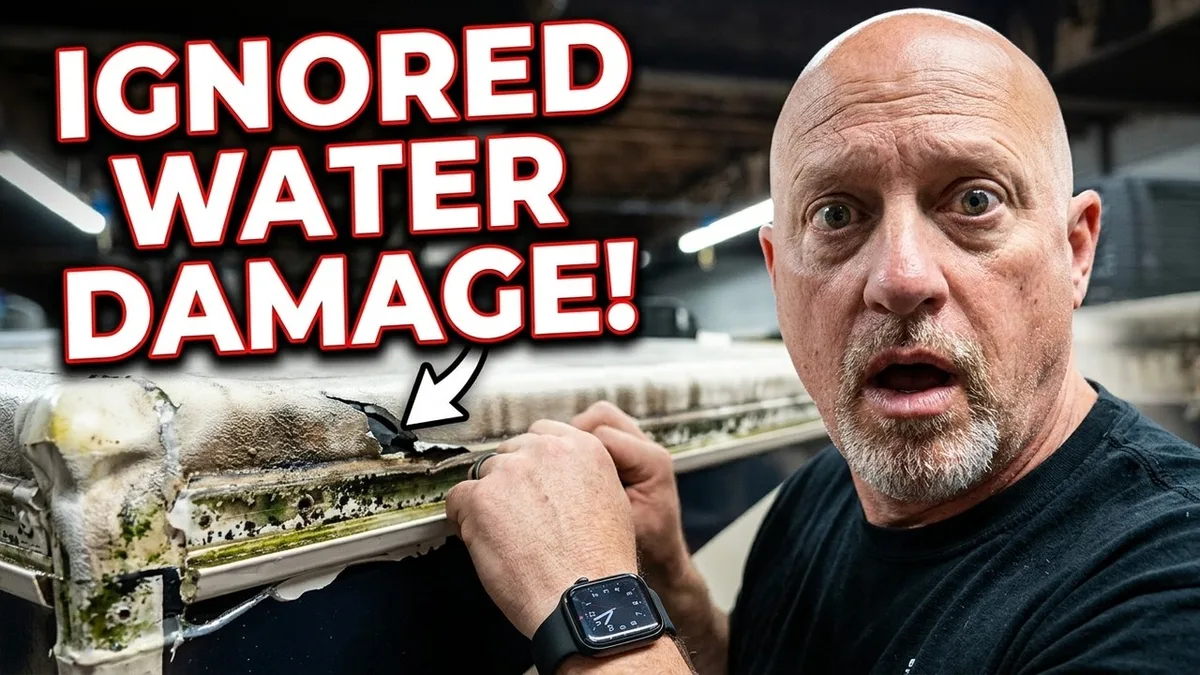
Image source: YouTube / Your RV Specialists (YouTube thumbnail (fair-use with source credit))
The Roof and Slide-Out Audit
The roof is the most expensive thing to replace on any camper. A new rubber roof (TPO or EPDM) runs $1,500 to $4,000 installed. If yours is cracking, bubbling, or has had previous patch jobs, deduct that amount from your asking price.
The same goes for slide-out seals. Torn or leaking seals are a red flag that screams "future water damage" to any informed buyer.
The Water Damage Check
Walk the entire interior with a moisture meter. Soft spots in the floor, delaminated walls, or bubbling wallpaper are all signs of active or past water intrusion. Even if you've fixed the leak, the damage lowers the value.
Buyers know that water damage in an RV is rarely fully resolved. Expect a 20-40% value hit for any visible water damage.
Tire Age and Battery Health
Tires older than five or six years are dangerous, even if tread looks fine. RV tires rot from the inside out. If your tires are date-coded 2019 or earlier, plan on replacing them.
That's $600 to $1,200 for a set of five or six tires. Buyers will deduct this from their offer.
Batteries are smaller but still matter. Dead or weak deep-cycle batteries mean another $200 to $400 expense. If yours are original and four-plus years old, budget for replacement.
Interior Wear and Appliance Condition
Normal wear is expected. Stained upholstery, worn countertops, and faded decals are cosmetic. But non-functional appliances (refrigerator, furnace, water heater) are deal-breakers.
A new RV fridge costs $1,200 to $2,500 installed. If anything doesn't work, price it accordingly or fix it before listing.
Step 5 – Account for Your Local Market and the Season
This is the hidden variable that most online tools miss. NADA and KBB give you national averages. Your local market might be drastically different.
If you live in a region with short camping seasons (like the Midwest or Northeast), spring and summer are prime selling months. List in March or April for the highest offers. Winter listings sit for months and attract lowball offers from serious but patient buyers.
If you're in a year-round camping destination (Arizona, Florida, Texas), demand is more consistent. But each region has brand preferences. Winnebago and Jayco sell well in the Midwest.
Airstream has strong national demand but commands a premium everywhere. Lance and Arctic Fox are favorites in the West for their cold-weather builds.
A quick way to check local demand: search your camper's make, model, and year on Facebook Marketplace or RVTrader. Note how many similar listings exist. If there are twenty campers like yours within 100 miles, you're in a buyer's market.
If there are two, you can price higher and wait for the right buyer.
Seasonal pricing swings of 10-20% are normal. Don't fight the market. Price realistically for your time and place, and you'll sell faster with fewer negotiations.